


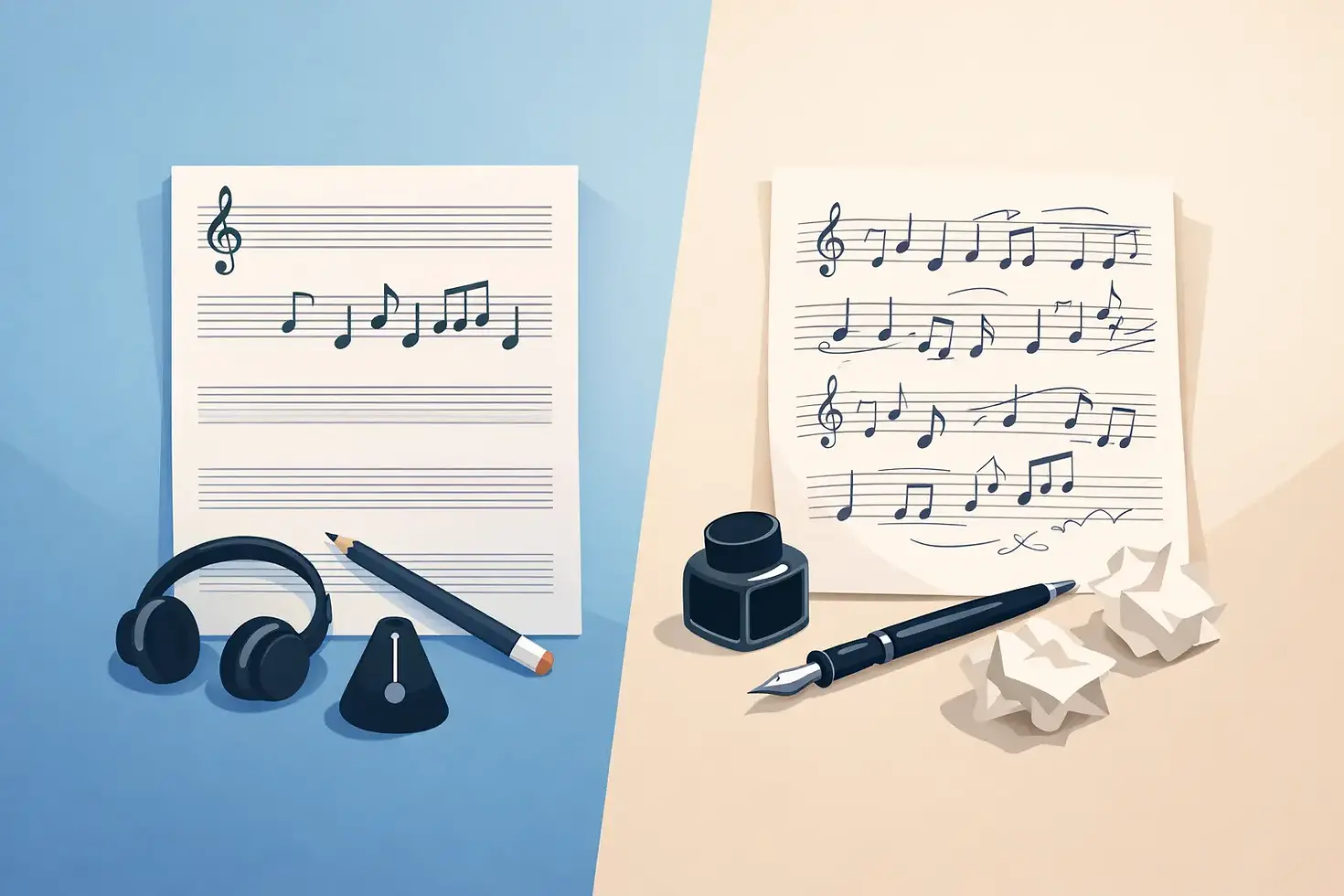
Staff Paper vs Manuscript Paper Explained
- mandgpublishing
- Apr 21
- 6 min read
If you've ever searched for blank music pages and ended up wondering whether you need staff paper or manuscript paper, you're not alone. The phrase staff paper vs manuscript paper causes a lot of confusion because people often use the terms to mean the same thing, while some sellers and teachers use them more specifically.
The short answer is this: in many everyday music settings, staff paper and manuscript paper are interchangeable. But depending on who is using the term, manuscript paper can sometimes mean a broader category of paper for writing music, while staff paper usually points more directly to pages with blank staves already printed on them. That small difference matters when you're buying notebooks, printing templates, or choosing materials for lessons.
Staff paper vs manuscript paper: the simple answer
Staff paper is blank paper printed with music staves. If you are writing notes for piano, voice, violin, flute, or most standard notation-based instruments, staff paper is the basic format you need.
Manuscript paper often refers to that same thing: blank paper with staves for handwritten notation. Many musicians, teachers, and music stores use manuscript paper as the traditional name and staff paper as the plain-language version. In practice, one person may ask for manuscript paper and another may ask for staff paper, and both expect the same product.
Where it gets tricky is that manuscript paper can also be used as a broader umbrella term. Some people use it to describe any paper designed for music writing, including grand staff paper, choir staff paper, guitar tab with rhythm lines, or mixed-format notation pages. So if you're ordering online, it helps to check the page layout instead of relying on the label alone.
Why the terms get mixed up
Music vocabulary has a way of carrying older terms forward. Manuscript paper has been around as a standard phrase for a long time, especially in formal music study, publishing, and composition settings. Staff paper sounds more direct and more obvious, which is why many students, parents, and hobby musicians prefer it.
Neither term is wrong. The issue is mostly one of context.
A piano teacher might say, "Bring manuscript paper next week," because that is the term they learned in school. A student shopping online might search "blank staff paper for piano" because it describes the page more clearly. Both are trying to solve the same problem: they need clean staves to write music on.
What staff paper usually means
When a product is labeled staff paper, you can usually expect a straightforward notation layout. That means evenly spaced five-line staves designed for writing pitches, rhythms, dynamics, and other musical markings by hand.
This is the most useful option for musicians who need a clean, readable page without extra elements. It works well for melody writing, theory assignments, sight-singing exercises, dictation, and sketching musical ideas quickly.
Staff paper can come in several versions. Some pages have a single staff repeated down the page. Others use larger spacing for beginners. Some are designed as grand staff paper for piano students, with treble and bass staves paired together. So even when the label says staff paper, the exact format still matters.
What manuscript paper can mean
Manuscript paper often means blank staff paper, but not always in a narrow sense. In some stores or catalogs, manuscript paper includes multiple notation-ready formats used for handwriting music.
For example, manuscript paper may refer to orchestral score paper with many staves per page, piano manuscript paper with brace-grouped grand staves, or educational pages meant for notation practice. The term can feel a little broader and a little more traditional.
That does not make it more advanced. A beginner can use manuscript paper just as easily as an experienced composer. The key question is not whether the name sounds formal. The key question is whether the layout matches the way you actually write and study music.
When the difference actually matters
In casual use, the difference often does not matter at all. If you need blank staves for handwritten notation, either term may get you where you need to go.
It matters more when you are buying for a specific purpose. If you're teaching early piano students, you may want large grand staff pages with generous spacing. If you're writing lead sheets, you may prefer more systems per page. If you're arranging for ensemble, you may need score paper rather than a simple single-staff layout.
This is where product names can be misleading. A notebook called manuscript paper may be perfect for one musician and frustrating for another. A printable called staff paper might be exactly right for flute practice but not ideal for a songwriter who wants chord boxes or lyric lines.
So instead of treating staff paper vs manuscript paper as a strict terminology battle, it is more useful to treat it as a layout check. Look at the number of staves, spacing, page size, and whether the format fits your instrument or task.
How to choose the right paper for your use
If you write standard notation for one melodic instrument, regular staff paper is usually enough. Students in band, orchestra, choir, and theory classes often do well with a simple blank staff layout that is easy to read and easy to mark up.
If you play piano, grand staff paper is usually the better choice. You can still hear it called manuscript paper, but what matters is that each system includes both treble and bass clefs. That gives you the right structure for two-hand writing, harmonization, and lesson assignments.
If you teach, readability should be high on your list. Clean line spacing saves time, reduces mistakes, and makes feedback easier. Crowded pages may look efficient, but they can slow down younger students and create unnecessary visual clutter.
If you are composing or arranging, your choice depends on how developed the idea is. Quick sketches often work best on simple staff paper. Full scoring needs a more specialized manuscript format with enough staves for multiple instruments.
If you are a guitarist or ukulele player, standard manuscript paper may not be enough on its own. You may need tablature paper, chord diagram pages, or hybrid sheets that combine staff notation and tab. This is one reason instrument-specific formats are so helpful. They remove the workaround stage and let you write immediately.
Common mistakes when buying blank music paper
One common mistake is assuming all blank music pages are basically the same. They are not. Staff size, spacing, page orientation, and system count all affect usability.
Another mistake is choosing the format by name alone. The label manuscript paper sounds official, but that does not tell you whether the lines are large enough for a beginner or compact enough for dense notation.
A third mistake is picking a general notebook when an instrument-specific layout would make practice easier. A piano student using single-staff pages or a guitarist trying to squeeze fretboard ideas onto plain notation paper will often end up frustrated. Good paper should reduce friction, not add it.
A practical rule you can use
If you want the simplest answer to staff paper vs manuscript paper, use this rule: if the page has printed music staves for handwriting notation, it is often fair to call it either staff paper or manuscript paper.
Then go one step further and ask what kind of notation job the paper needs to handle. Solo instrument work, piano study, songwriting, theory homework, and ensemble scoring all place different demands on the page.
That is why practical musicians usually care less about the terminology after a while. Once you've used enough templates, you start noticing what really matters: line spacing, page clarity, room for markings, and whether the format supports the way you practice or teach.
At My Amazing Journals, that is the reason so much attention goes into clean music layouts. Musicians do better work when the page is built for the task in front of them.
So which term should you use?
Use the term that feels natural for your setting, but be specific when you shop or print. If you say staff paper, most people will understand you want blank music staves. If you say manuscript paper, most musicians and teachers will also understand, though the format may be interpreted a little more broadly.
When clarity matters, name the exact layout instead. Say piano grand staff paper, blank treble clef staff paper, guitar tab paper, or orchestral score paper. That removes guesswork and gets you a page you can actually use.
The best paper is not the one with the fanciest name. It is the one that makes it easier to write the next exercise, lesson example, melody, or practice note without stopping to fight the format.


Comments